
Video Ad five films · 20 seconds · 24 fps
Five twenty-second films of labs.llc, made from its own pages.
All five films back to back — a fresh shuffle every press, drawn with your browser’s cryptographic random numbers.
Each one answers the same brief. A cursor clicks in a dark void and the site opens; five of its real tools take a beat each; everything folds back into the LABS plate and the address types itself underneath. Every screen in them is a labs.llc page, and every number that counts up is true of the site.
The brief: Hookframe 000 of 480
01 — The films
Same brief, five different films
Press a picture to play it with sound. Under each one is every file it comes in — the resolution, the codec and the size read off the file itself.
back to back, a fresh shuffle every press
-

Film 01 Blender · Eevee
Glass Orbit
The brief played straight: a click detonates a floating glass website, and one camera orbits a ring of real labs.llc panels, a sixth of the way round for every beat.
On screen: Media Wall, News Hub, Rates, EQ, Buy Domains, Card, Portal
- 16:91920 × 1080 · H.264 High · AAC19.8 MB
- 9:161080 × 1920 · H.264 High · AAC26.1 MB
- 1:11080 × 1080 · H.264 High · AAC26.1 MB
- Loop1920 × 1080 · VP9 · silent7.5 MB
- Loop960 × 540 · VP9 · silent2.8 MB
- Loop960 × 540 · H.264 High · silent3.1 MB
- Poster1920 × 1080 · JPEG 311 KB, WebP 110 KB421 KB
- 4K3840 × 2160 · H.264 High · AAC113 MB
- 4K3840 × 2160 · HEVC · AAC49.5 MB
-

Film 02 three.js · WebGL
Hyperlane
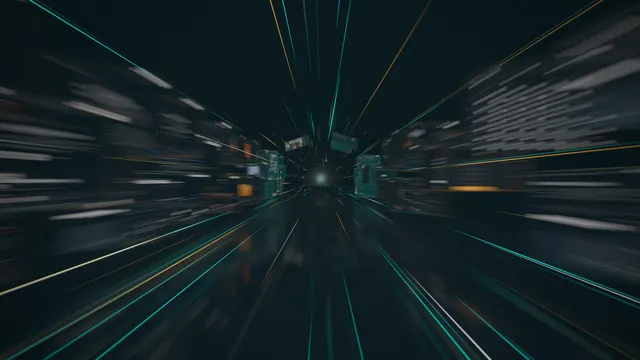
One continuous flight down a corridor lined with real labs.llc screens; on every beat the camera brakes at a station and one screen swings round to face the lens.
On screen: Media Wall, News Hub, EQ, Product Lab, Card, Buy Domains, the rooms
- 16:91920 × 1080 · H.264 High · AAC20.8 MB
- 9:161080 × 1920 · H.264 High · AAC30.3 MB
- 1:11080 × 1080 · H.264 High · AAC22.7 MB
- Loop1920 × 1080 · VP9 · silent7.5 MB
- Loop960 × 540 · VP9 · silent2.8 MB
- Loop960 × 540 · H.264 High · silent3.1 MB
- Poster1920 × 1080 · JPEG 123 KB, WebP 27 KB149 KB
- 4K3840 × 2160 · H.264 High · AAC111 MB
- 4K3840 × 2160 · HEVC · AAC45.4 MB
-

Film 03 Blender · Eevee
Iso City
labs.llc as a miniature city at dusk on an open pop-up book, every building a tool with its real screen on the facade; at the payoff the book closes, and its cover is the LABS plate.
On screen: Media Wall, File Search, Glass, News Hub, EQ, Product Lab, Buy Domains, Portal
- 16:91920 × 1080 · H.264 High · AAC20.4 MB
- 9:161080 × 1920 · H.264 High · AAC27.6 MB
- 1:11080 × 1080 · H.264 High · AAC22.9 MB
- Loop1920 × 1080 · VP9 · silent10.4 MB
- Loop960 × 540 · VP9 · silent2.8 MB
- Loop960 × 540 · H.264 High · silent3.0 MB
- Poster1920 × 1080 · JPEG 71 KB, WebP 22 KB93 KB
- 4K3840 × 2160 · H.264 High · AAC114 MB
- 4K3840 × 2160 · HEVC · AAC50.7 MB
-

Film 04 Canvas · WebGL
Swiss Grid
International Typographic Style in motion: one strict grid, huge numerals that count to the site's real figures, real screens in the cells, and a hard cut on every hit.
On screen: Media Wall, Glass, News Hub, EQ, Product Lab, Buy Domains, the rooms
- 16:91920 × 1080 · H.264 High · AAC20.9 MB
- 9:161080 × 1920 · H.264 High · AAC26.0 MB
- 1:11080 × 1080 · H.264 High · AAC20.9 MB
- Loop1920 × 1080 · VP9 · silent6.8 MB
- Loop960 × 540 · VP9 · silent2.6 MB
- Loop960 × 540 · H.264 High · silent3.1 MB
- Poster1920 × 1080 · JPEG 141 KB, WebP 28 KB169 KB
- 4K3840 × 2160 · H.264 High · AAC115 MB
- 4K3840 × 2160 · HEVC · AAC49.7 MB
-
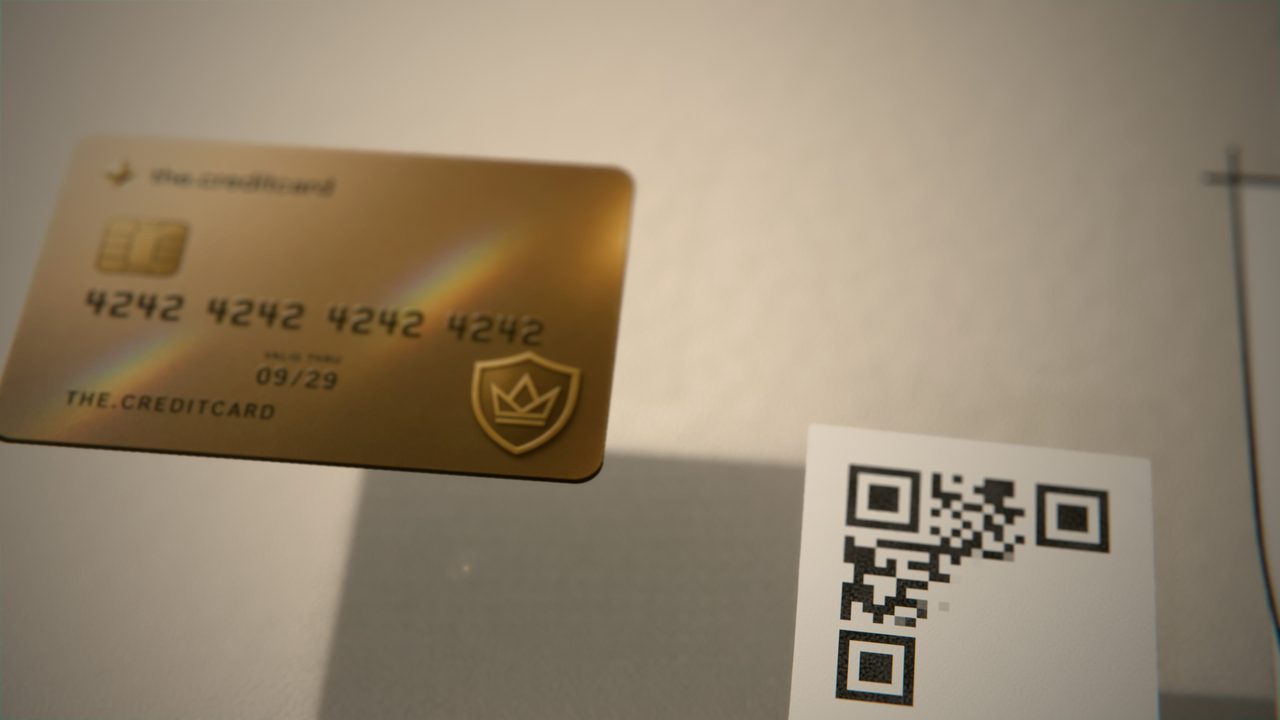
Film 05 Blender · Eevee
Ink to Light
The paper edition's film: the site is drawn in ink on cream cotton paper under a raking gold light, and every drawing develops into the real page like a print in a darkroom tray.
On screen: Media Wall, Rates, Figures, EQ, Card, Buy Domains, the rooms
- 16:91920 × 1080 · H.264 High · AAC21.5 MB
- 9:161080 × 1920 · H.264 High · AAC26.6 MB
- 1:11080 × 1080 · H.264 High · AAC26.9 MB
- Loop1920 × 1080 · VP9 · silent5.9 MB
- Loop960 × 540 · VP9 · silent2.8 MB
- Loop960 × 540 · H.264 High · silent3.3 MB
- Poster1920 × 1080 · JPEG 729 KB, WebP 478 KB1.2 MB
- 4K3840 × 2160 · H.264 High · AAC124 MB
- 4K3840 × 2160 · HEVC · AAC51.0 MB






02 — Formats
Every file, measured
Each film is cut for the place it will play: 16:9 for a page or a screen, 9:16 for a phone held upright, 1:1 for a feed, and a silent loop for the top of a website. The 9:16 and 1:1 cuts were rendered again with their own camera and layout rather than cropped out of the wide one. Sizes are the bytes on disk.
| Format | Frame | Codec | Bitrate | Glass Orbit | Hyperlane | Iso City | Swiss Grid | Ink to Light |
|---|---|---|---|---|---|---|---|---|
| 16:9 webwith sound | 1920 × 1080 | H.264 High · AAC | 7.9–8.6 Mb/s | 19.8 MB | 20.8 MB | 20.4 MB | 20.9 MB | 21.5 MB |
| 9:16 socialwith sound | 1080 × 1920 | H.264 High · AAC | 10.4–12.1 Mb/s | 26.1 MB | 30.3 MB | 27.6 MB | 26.0 MB | 26.6 MB |
| 1:1 squarewith sound | 1080 × 1080 | H.264 High · AAC | 8.3–10.8 Mb/s | 26.1 MB | 22.7 MB | 22.9 MB | 20.9 MB | 26.9 MB |
| Silent loop, WebMmuted | 1920 × 1080 | VP9 · silent | 2.4–4.2 Mb/s | 7.5 MB | 7.5 MB | 10.4 MB | 6.8 MB | 5.9 MB |
| Silent loop 540p, WebMmuted | 960 × 540 | VP9 · silent | 1.0–1.1 Mb/s | 2.8 MB | 2.8 MB | 2.8 MB | 2.6 MB | 2.8 MB |
| Silent loop 540p, MP4muted | 960 × 540 | H.264 High · silent | 1.2–1.3 Mb/s | 3.1 MB | 3.1 MB | 3.0 MB | 3.1 MB | 3.3 MB |
| Poster, JPEGthe payoff frame | 1920 × 1080 | JPEG | — | 311 KB | 123 KB | 71 KB | 141 KB | 729 KB |
| Poster, WebPthe payoff frame | 1920 × 1080 | WebP | — | 110 KB | 27 KB | 22 KB | 28 KB | 478 KB |
| 4K master, H.264with sound | 3840 × 2160 | H.264 High · AAC | 44.4–49.7 Mb/s | 113 MB | 111 MB | 114 MB | 115 MB | 124 MB |
| 4K master, HEVCwith sound | 3840 × 2160 | HEVC · AAC | 18.1–20.4 Mb/s | 49.5 MB | 45.4 MB | 50.7 MB | 49.7 MB | 51.0 MB |
| Every file of the film | 249 MB | 244 MB | 252 MB | 245 MB | 263 MB | |||





03 — The brief
Twenty seconds, cut to the frame
The owner's brief asked for a cinematic twenty-second promo: ultra-smooth motion graphics mixed with the site's real interface, graded deep charcoal with electric teal and warm gold. All five films keep one cue sheet at 24 frames a second, so every cut lands on the same frame and every soundtrack hit lands with it.
-
Hook 0–3 s · frames 0–71
A dark void. A single glowing cursor clicks, and the click opens into a floating website that unfolds like a living product while the camera slowly orbits: panels, dashboards and tool cards snap into place, soft glass, faint particle trails.
-
Feature montage 3–14 s · frames 72–335
Five beats of about two seconds, fast but readable, joined by morphs, gentle push-ins and lateral slides, with the odd tap on a button for scale.
- Files and media. Thumbnails fly into a grid, filters slide, a file previews in depth.
- Analytics. Charts rise, numbers count up, live data pulses — and only to numbers that are true of the site today.
- The lab. Geometric forms turn and light refracts through glass.
- Commerce and utility. Product cards flip, a QR code generates — a real one, that scans to https://labs.llc — and checkout glows.
- The hub. Tools connect with glowing lines: everything in one place.
-
Payoff 14–18 s · frames 336–431
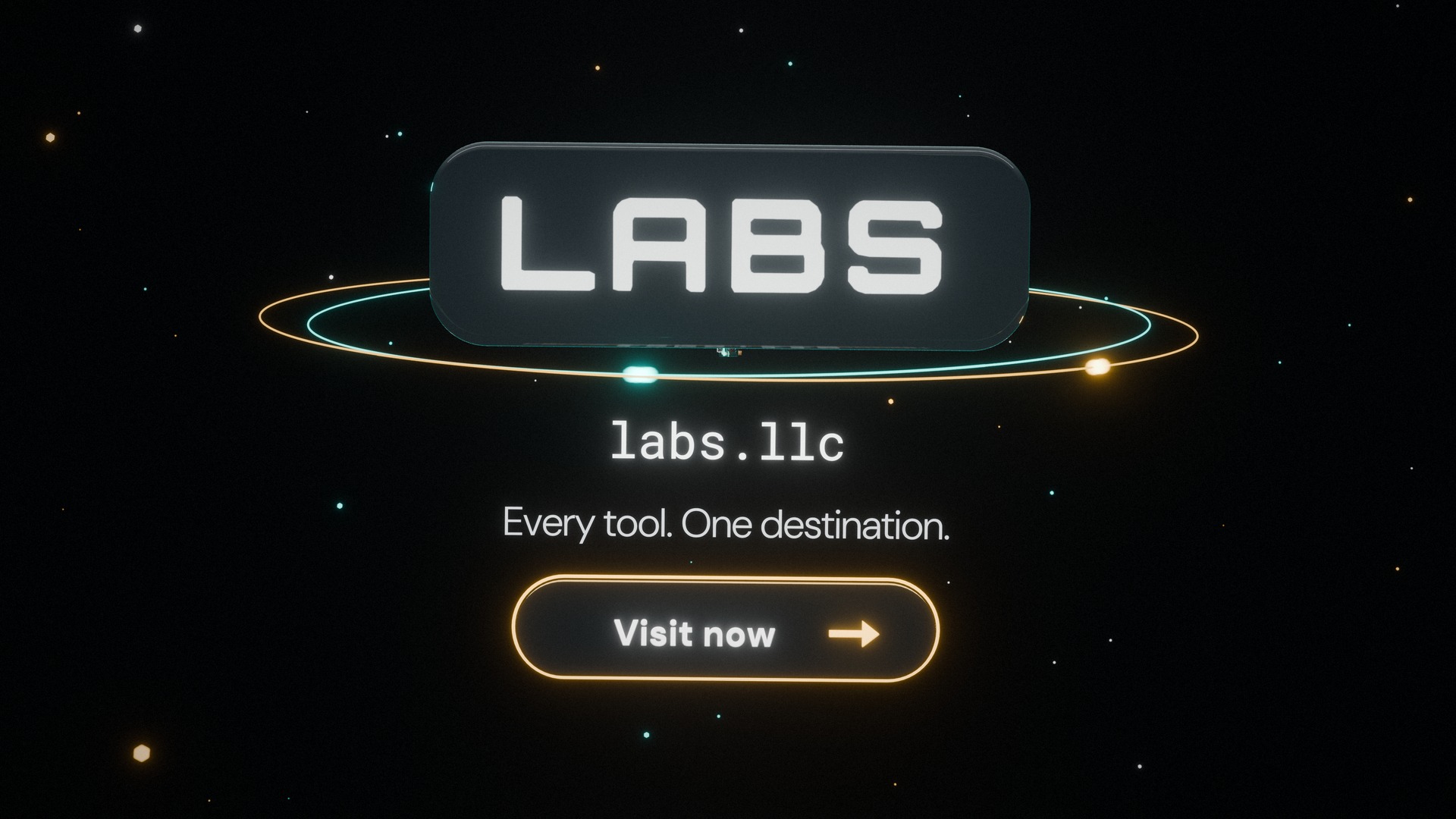
Every panel collapses and reassembles into the LABS plate. The address labs.llc types itself underneath, then the line Every tool. One destination. A soft flare and a sweep of light.
-
Call to action 18–20 s · frames 432–479
Visit now and the address, held for two seconds, with a small idle movement on the plate — a clean hold that loops back into the opening.
04 — How they were made
Rendered here, from the site itself
The pictures of the site are the site. Every screen that appears in a film is a labs.llc page, served from this build's own files on the machine that made the films and photographed in a headless browser — with the analytics tag blocked and nothing fetched from labs.llc itself. Where a page shows live data, the reading is the one it showed when it was photographed; nothing on a screen was painted in afterwards.
The numbers are the site's. A number that counts up in a film is one the site already states and can show its working for — displays in EQ, wires on the News Hub, photographs on the Media Wall, plates in Product Lab, pages in the search index. No invented metric, no invented brand, no stock faces.
The films were rendered locally, frame by frame at 24 frames a second, on one shared machine — each film's line says at what size and how long it took — then encoded with ffmpeg into every format on this page. The 9:16 and 1:1 cuts were rendered again for their own frame, not cropped. Each soundtrack was written for its film against the same cue sheet, with the hits placed on the cut frames, and levelled with ffmpeg's loudnorm to −14 LUFS and a −1 dB true peak; what every file actually measures is in the specs below.
What a film here is not: footage of anyone, a mock-up of a page that does not exist, or a number the site would not stand behind.

Glass OrbitBlender · Eevee
One procedural Blender scene in Eevee: every screen an emissive capture behind a bevelled glass slab with ray-traced refraction, 180° motion blur, depth of field with focus racks, bloom and anamorphic glare; 16–24 samples. The 16:9 was rendered at 3840 × 2160 in about 94 minutes of shared GPU time; the 9:16 and 1:1 were re-composed and rendered at their own size in about 14 and 7 minutes.
Hyperlanethree.js · WebGL
three.js WebGL2 in headless Chrome, every frame a pure function of its number and averaged from 64 sub-frames (180° shutter, real depth of field, anti-aliasing), then bloom, anamorphic streaks, flare and grain. The 16:9 was rendered at 3840 × 2160 in about 16.5 minutes; the 9:16 and 1:1 were re-rendered from the same scene with their own cameras, in 6 and 2.5 minutes.

Iso CityBlender · Eevee
One Blender script builds the whole city and bakes every frame: pop-up buildings wearing the captures, a ray-traced glass dome, tilt-shift depth of field on a 66–150 mm lens, haze and bloom, then a 2D pass for the captions and count-ups. The 16:9 was rendered at 3840 × 2160; the 9:16 and 1:1 were re-composed with their own cameras and rendered at their own size, in about 10 and 8.5 minutes.

Swiss GridCanvas · WebGL
Canvas 2D drawn into three depth layers and placed in 3D by WebGL2 in headless Chrome, with the time passed in for every frame; 24 accumulated sub-frames (72 on fast motion) for a 180° shutter, depth of field, bloom and grain. The 16:9 was rendered at 3840 × 2160 in about 17 minutes; the 9:16 and 1:1 were re-set for their own frames and rendered at twice their size, in 20 and 14 minutes.

Ink to LightBlender · Eevee
One Blender scene built from Python: each capture is traced to ink line art, and one shader develops it back into the screenshot. Eevee with motion blur and depth of field, 12–14 samples. The 16:9 is rendered natively at 3840 × 2160, 480 frames in 22 minutes at about 2.8 s a frame; the 9:16 and 1:1 were re-composed with their own cameras and rendered at their own size.
05 — Specs
The numbers, off the files
Measured from the files this page serves: dimensions, codecs and bitrates by ffprobe, loudness by ffmpeg's EBU R128 meter.
| Length | 20.000 s · 480 frames |
|---|---|
| Frame rate | 24 fps |
| Picture | Rec.709, TV range · 4:2:0, 8-bit |
| 16:9 web | 1920 × 1080 · H.264 High · AAC · 7.9–8.6 Mb/s |
| 9:16 social | 1080 × 1920 · H.264 High · AAC · 10.4–12.1 Mb/s |
| 1:1 square | 1080 × 1080 · H.264 High · AAC · 8.3–10.8 Mb/s |
| Silent loop, WebM | 1920 × 1080 · VP9 · silent · 2.4–4.2 Mb/s |
| Silent loop 540p, WebM | 960 × 540 · VP9 · silent · 1.0–1.1 Mb/s |
| Silent loop 540p, MP4 | 960 × 540 · H.264 High · silent · 1.2–1.3 Mb/s |
| 4K master, H.264 | 3840 × 2160 · H.264 High · AAC · 44.4–49.7 Mb/s |
| 4K master, HEVC | 3840 × 2160 · HEVC · AAC · 18.1–20.4 Mb/s |
| Sound | AAC, 48 kHz, stereo · 194–278 kb/s |
| Loudness | integrated −14.1 to −13.9 LUFS · true peak −1.6 to −1.1 dBTP |